
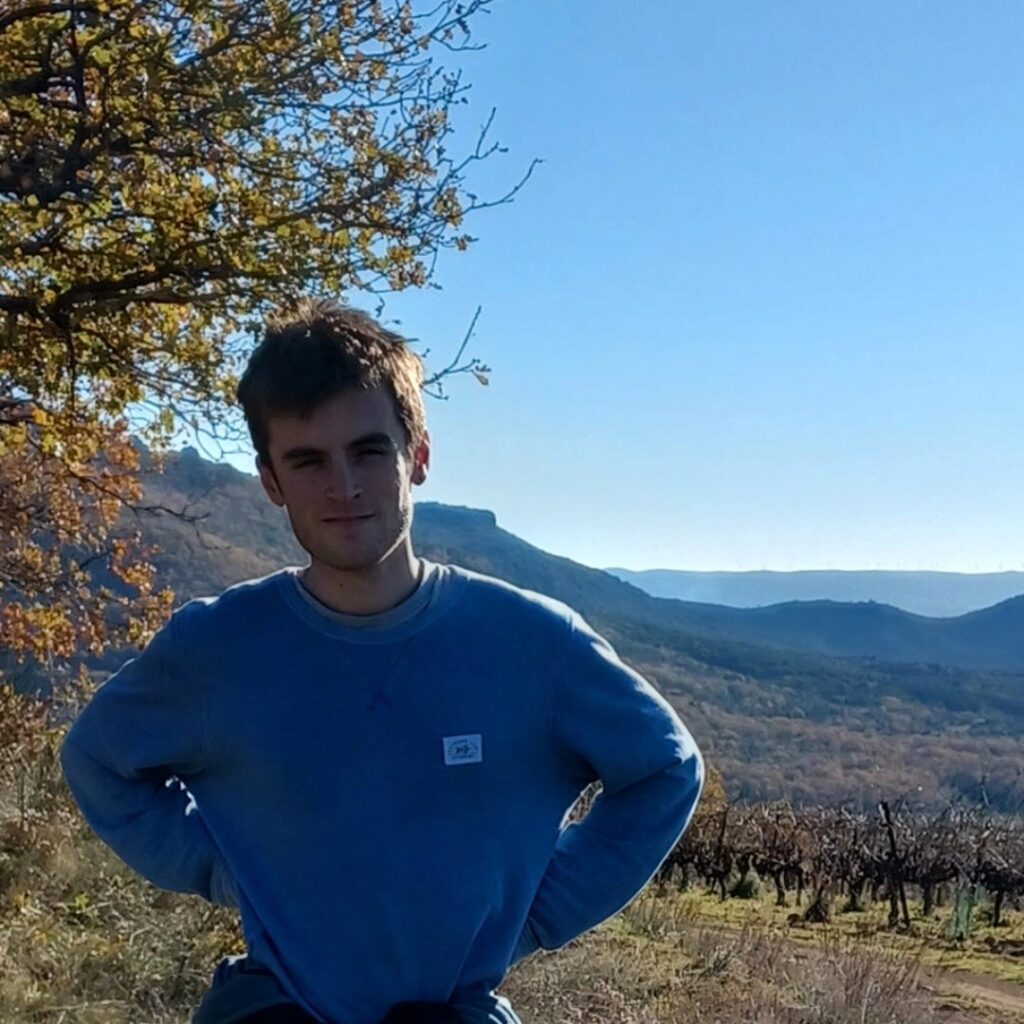
Caradoc Gayer’s story “All the City Lights” appeared in our Bloom collection and is an atmospheric story, sweeping into conversations that occur in European cafes and evening rooftops.
Caradoc Gayer is a young music and culture journalist from England, who became obsessed with stories, particularly fantasy novels, from a young age. In 2020 he moved to Nottingham, the home of Robin Hood, to study English Literature, where he found himself enthralled by the city’s buzzing arts scene, its sweeping green spaces, and the creative and ambitious people he met day-to-day while studying. After hosting music shows on his student radio and a stint in a short-lived indie covers band, he completed a master’s degree in journalism and stayed in Nottingham to work at its resident arts and culture magazine, LeftLion. Through those years his love for a good story remained strong, and he hopes to continue building a life around the written word. You can keep up with his journalistic and literary pursuits via his website muckrack.com/caradoc-gayer-1 and Instagram @caradoc_g.
At what point did you consider yourself a writer?
I think that the inner feeling of ‘being a writer’ is something that I’ve held inside, and known about myself, from a very early age – probably since I was about seven or eight years old. I spent a lot of my childhood writing in notebooks about fantasy worlds, which were half-invented, half-stolen from books I was reading at the time. This instinct overlapped with an interest in unusual, complicated words, and to put stories on paper, not just hold them in my head. I remember receiving a school report at about nine – the teacher had kindly written that I had a real talent for writing. I think from that point on I knew it would always be something central to who I am; a natural place I go to for solace and flexing creative muscles. The good thing about writing, I think, is that it’s one of the least ‘gate-kept’ art forms – everyone has some experience with it, so it’s not too tricky to tap into its creative wells and consider yourself a ‘writer’. It’s not really the same with music, for example.
Give us a peek into your writing process.
Nowadays my life as a writer is a little different to how I expected it to be as a kid, but still fulfilling. After completing a Master’s Degree in journalism, I was lucky enough to be hired part-time as a culture journalist and have worked in that field for about a year. Writing articles works a little differently to stories – it’s more structured and measured – there’s more of a formula whereby you choose the right quotes from your interviewee, then build the story around that, before scouring what you’ve written for the passive voice and incinerating it, trying to complete the whole thing in two to three hours.
Back in my undergraduate degree, two years ago, I wrote more stories than I do now, including early bones of the story featured in Dandelion Revolution Press’ latest anthology.
During that time, I found my fiction writing process was a bit haphazard and neurotic: treat yourself well, be in green space and get some fresh air. Once an idea comes, write the starting paragraph without thinking too much. Then spend about an hour changing every clause in said paragraph to the best one possible, then look at the clock and realize it’s half eleven at night. Two days or so later, the flow state comes and you write the whole thing – hopefully.
In your opinion, what separates a good short story from a great short story?
I hate to get too pretentious, but I think I’m going to have to be – the best short stories that I’ve read tap into universal emotions: hyper-specific times and situations where people experience a distinctive quality of joy, peace, terror, grief, etc. Even if you haven’t been in the situation that the author is describing, you’ll still recognize that you’ve experienced those emotions yourself.
I’ve heard authors say that coming up with ideas for stories is just ‘practice,’ but recognizing instinctively when an idea has the potential to be ‘great.’ I really agree with that, and it’s a skill I’m still developing myself.
What is a short story you believe everyone should read?
This is tough as I’ve read many great ones in my time – especially at university. I might have to give three: Chapter 2, from All That Man Is, by David Szalay (captures something uniquely comedic and equally melancholy about being a young, early 20s guy in the West), Looking for Jake by China Mieville (it’s a masterclass in creating an immersive dystopia with limited pages), and The Pier Falls by Mark Haddon (terrifying, horrific, and un-put-downable).
What other creative projects are you working on? How can readers find your other writing (and future writings)?
I work for LeftLion Magazine right now: probably the UK’s most successful local culture magazine which covers the art, music, theatre, sport, and community action happening in Nottingham: the city of Robin Hood. I’m very passionate about the magazine and the city it represents, and it’s allowed me to speak to some fascinating creative people. So, if that sounds interesting check out the website, and maybe it’ll make you want to visit Nottingham. You can keep up with the articles I write, and the freelance music writing I’ve been doing on my Muck Rack portfolio and my Instagram. I also have many more stories floating around in my head, and when the time is right, I definitely want to find homes for them, and get eyes on them. So, watch this space.
What was the inspiration behind your story featured in DRP’s journal?
The idea first stemmed from when my little sister went out to visit one of her best friends in Florence, Italy, a girl who is an excellent artist, and at the time was studying art in the city. I thought about that, and there seemed to be a unique kind of coming-of-age, Mediterranean magic in going on that kind of trip. To make the story more like fiction, more ‘my own’, I changed the setting to Toulouse, France, a city which captured my imagination when I visited it at eighteen with a friend.
I was also reading a lot of Ali Smith at the time: she’s a Scottish writer who I think is a true expert at representing what it’s like to be living ‘now’ – post internet, 9/11, and financial crash, with too much anxiety and information floating around in our heads, but also the pure, pure joy of human connection in context of all of that. As I wrote, trying to subtly imitate Ali Smith, I started thinking about the uniqueness of relationships between women too, whether they’re romantic or platonic. There’s a kind of open, free-flowing quality which a lot of guys like myself could do with having in our lives. And then I thought – well, this story has got to be firmly from the perspective of one person, then: someone locked in her thoughts and anxieties who finds solace in the openness of the women around her. After that, the story more or less emerged by itself.
What do you hope readers will get out of your short story featured in DRP’s journal?
Just a joy, really – a delight in the simple things, an instinct to feel everything as deeply as possible, good or bad, and to see people and things you might take for granted in a new light. I often feel like there’s a ‘fiction-worthy-story’ going on inside our own minds all the time, one which ideally and hopefully has a happy ending if you want there to be. I tried to represent that in All of the City Lights. The story reminds me of that, and I hope it does for readers too.